 Dig Deep Races
Route card · 50 miles · Saturday 6am
Peak Trails 50: a 50-mile Peak District ultra below the full tour
- 50 milesDistance
- about 2,600 mAscent
- 6amStart
- 18Minimum age
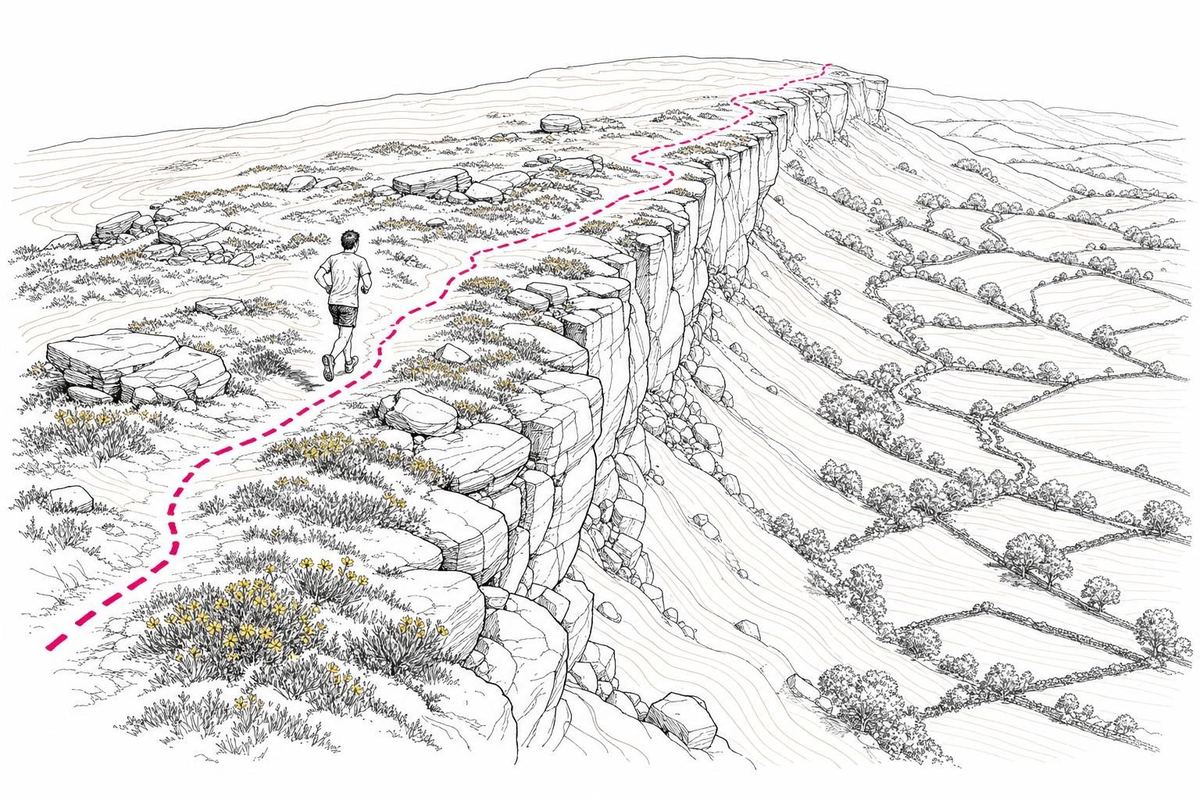
Peak Trails 50 fills the gap that many runners felt between the 30-mile intro ultra and the 60-mile Ultra Tour. It is 50 miles with about 2,600 metres of climbing, it started at 6am alongside the longest race, and in the race's own words it took in "some of the finest trails in the Peak District" without a single monster climb.
What 50 miles on these trails looks like
The 50-mile race joined the weekend after 2016, and for 2018 it moved to a new line, like the 60-mile route, because of land-use restrictions. The change added climbing. The published figures were 50 miles and about 2,600 metres of ascent. That works out at around 52 metres of climbing per mile, almost the same rate as the 60-mile route and noticeably more than the 30.
In practice that means the 50 is not a softer version of the long race. It is the same kind of day, just shorter: steady climbing, rough descents, and the cumulative fatigue that only shows after six or seven hours. What it leaves out is the final section, and for slower runners the final section of the 60-mile route is the one run in the dark.
Start, registration and rules
- Start: 6am at Whirlow Hall Farm, after a 5.40am briefing.
- Registration: the evening before, between 3pm and 6pm and again from 8pm to 10pm. Morning registration from 5am was for emergencies only.
- Timing: SportIdent dibbing stations along the route, each of which had to be visited.
- Cut-offs: strict cut-off times at every support station.
- Marking: partially marked, with navigation possibly needed.
- Poles and pacers: poles allowed, pacers not.
- Age: minimum 18, no upper limit. Veteran categories started at 40, with separate categories for over-50s.
The entry fee in 2018 was £50 and covered food and drink at the feed stations, dibber timing, route notes by email, a T-shirt, a medal and food after the finish.
Penalties, maps and recce days
Missing a dibbing point on the 50 did not mean automatic disqualification, as it did on the 12.12. Each point carried its own penalty instead. The rules set two limits on that system: a penalty could be overruled when a dibber at an unmanned checkpoint had clearly been tampered with or removed, and no penalty was changed after the race on the strength of GPS tracks or anecdotal evidence. In practice the dibber record was what counted.
Two things could be booked alongside an entry: a printed race map and a place on a recce day over parts of the route. Entry was by advance booking only, and race numbers were handed out at registration. The 2018 race ran on 25 August, with six prize categories: senior, veteran (over 40) and over-50, each for men and women.
Mandatory kit
- full body cover, windproof and waterproof
- compass and full route map
- spare water and food
- whistle
- mobile phone
A head torch was not on the published 50-mile list, but the race rules referred to head torches being left at the Bradwell checkpoint, the same rule as for the 60-mile race. Anyone moving slowly on a 50-mile day that starts at 6am should carry one anyway. A 14-hour finish brings runners home around sunset.
Is the 50 the right next step?
The 50 makes most sense for runners who have finished a 30-mile ultra comfortably and want to find out how their body handles a much longer day before committing to the full loop. A few honest questions help:
- Did the 30 feel controlled in the last hour, or was it a survival shuffle?
- Can you navigate with a map and compass when the cloud is down on the moor?
- Have you eaten real food while running for more than six hours?
- Have you done back-to-back long days in training?
Two or more answers of "no" suggest another season at the 30-mile distance first. Four answers of "yes" and the 50 is a realistic goal, with the Ultra Tour of the Peak District as the logical step after it. All the distances are compared on the races overview.
Training for fifty hilly miles
Most of the preparation for a 50-mile race happens in the long run. Back-to-back days on hilly ground, such as four hours on the Saturday and two or three on the Sunday, teach the legs to work when they are already tired, which is exactly how the second half of the race feels. Practise walking the climbs with purpose and eating something solid every hour, and run at least one long outing in the kit that has to be carried on the day, so a full pack does not feel new at the start line.
Questions about Peak Trails 50
How much climbing is on the 50-mile route?
About 2,600 metres of ascent over 50 miles.
When did it start?
At 6am, at the same time as the 60-mile Ultra Tour.
Was a head torch needed?
It was not on the published mandatory list, but slower runners on a long August day will finish around sunset, so carrying one is sensible.
Were poles allowed?
Yes. Pacers were not.
How does it compare with the 60-mile race?
It climbs at almost the same rate per mile, but is about ten miles shorter and avoids most of the night running.