 Dig Deep Races
Route card · 30 miles · Saturday 8am
A Peak District ultra over 30 miles: Peak Trails 30 as a first ultra
- 30 milesDistance
- 1,388 mAscent
- 8amStart
- 18Minimum age
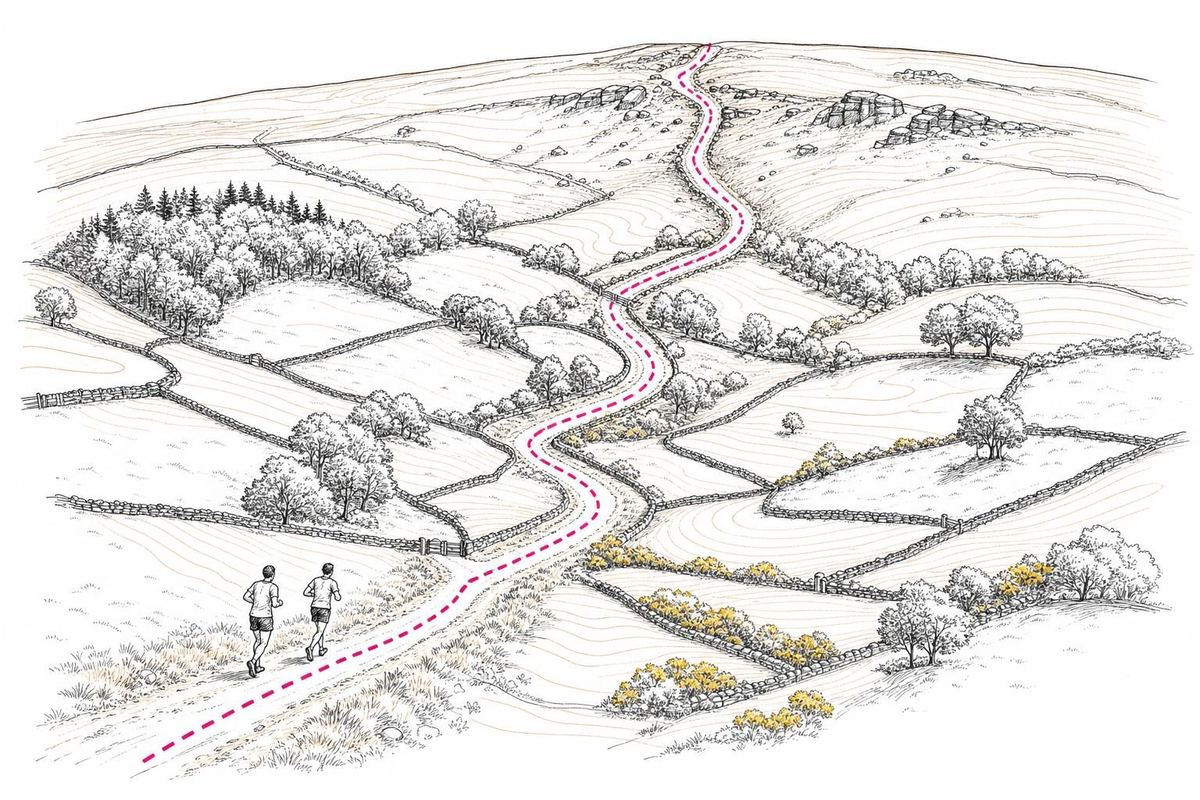
Peak Trails 30 began life as the Intro Ultra, and the name said exactly what it was for. At 30 miles with about 1,388 metres of climbing, it is a Peak District ultra that sits just over the marathon line, starts two hours after the long races, and uses the same farm, the same moors and the same rules. For a first ultra close to Sheffield, no Peak District ultra offers a cleaner step up.
The race information never pretended it was easy. "No monster climbs", it said, "but the continued hilly nature of the course earmarks this race as a tough one to complete." Then came the line that made it popular: if you are after your first ultra scalp, this could be the one.
Why 30 miles works as a first ultra
Anything longer than a marathon counts as an ultra. A 30 mile ultra is the shortest distance that clears the bar with some margin, and on this course it brings three things that make a first attempt manageable:
- A later start. The 30-mile race set off at 8am, two hours after the 50 and the 60, with the briefing at 7.40am. Fewer runners needed a head torch at any point.
- Climbing that stays in proportion. At about 46 metres per mile it climbs at a lower average rate than the longer routes, which sit above 50.
- A day, not a day and a night. Unlike the 60-mile race, the 30 had no head torch on its mandatory kit list. It was planned as a daylight run, which takes one of the hardest parts of ultra running, keeping going in the dark, out of the equation.
That is why the intro ultra works as a stepping stone. The natural next steps from it are the Peak Trails 50 and, after that, the full Ultra Tour of the Peak District.
The route over 30 miles of Peak District trails
The course started and finished at Whirlow Hall Farm and took in some of the best trail running in the Peak District within a day's loop of Sheffield. Most of it ran on good tracks and public rights of way, with some rougher ground where, in the words of the briefing, navigation skills may be needed.
Like the longer routes, it was planned with landowners and the Peak District National Park Authority, with strict restrictions on some sensitive sections. In 2016 the route was fully marked; in 2018 it was partially marked, and navigation could be necessary. Runners who recce it today should use public paths and access land and carry a map.
Checkpoints, dibbers and penalties
The intro ultra ran on SportIdent timing, with a dibbing station at each checkpoint. Every one had to be visited, and the 2018 rules spelled out exactly what a miss would cost:
| Checkpoint | Penalty if missed |
|---|---|
| 1 | 30 minutes |
| 2 | 30 minutes |
| 3 | 10 minutes |
| 4 | 10 minutes |
| 5 | 30 minutes |
| 6 | 30 minutes |
| 7 | 30 minutes |
| 8 | 20 minutes |
| 9 | 50 minutes |
| 10 | 25 minutes |
| 11 | 30 minutes |
Missing two checkpoints in a row added a further hour, so checkpoint 9, with the heaviest single penalty, was the one not to miss. There were also strict cut-off times at each support station, so a first-timer could not simply walk the whole course at leisure.
Kit for a first Peak District ultra
The mandatory kit list was short:
- full body cover, windproof and waterproof
- compass and full route map
- spare water and food
- whistle
- mobile phone
For a first ultra a few extras are worth the weight. A light warm layer covers a slow afternoon on the tops. A pack that has been worn on long training runs avoids chafing that only appears after four hours. And food that has been tested in training matters more on a 30 mile ultra than any gadget: the classic first-ultra failure is not the legs giving up but the stomach.
A 12-week build for the intro ultra
Anyone who has run a trail marathon can prepare for this distance in about three months. A typical shape looks like this:
- Weeks 1 to 4. Build weekly time on feet, with one long run that reaches three to four hours on hilly trails. Include walking on the steep climbs from the start.
- Weeks 5 to 8. Add a back-to-back weekend every other week, for example four hours on Saturday and two on Sunday. Practise eating on every long run.
- Weeks 9 and 10. One long recce of part of the route or similar ground, five to six hours, with the full kit list in the pack.
- Weeks 11 and 12. Ease off. Shorter runs, some hills kept in, and plenty of sleep. The fitness is already there.
The 12.12 makes a good stepping stone on the way: 19.5 kilometres of the same kind of ground, short enough to race hard and long enough to show how the legs respond to the climbing.
Peak District ultra or Suffolk ultra?
The same race weekend format also ran in Suffolk, with a 28-mile intro ultra on much flatter ground through Rendlesham Forest and Snape. For a runner who wants the distance without the climbing, that was the gentler option. For a runner who wants to know whether hills and ultras go together, the Peak District ultra answers the question in one day. Both are described on the Suffolk page and the races overview.
Questions about Peak Trails 30
Is Peak Trails 30 the same as the Intro Ultra?
Yes. The race was originally called the Intro Ultra and was later renamed Peak Trails 30.
How much climbing is there?
About 1,388 metres over 30 miles.
What time does it start?
8am, with a briefing at 7.40am, two hours after the 50 and 60-mile races.
Is it really an ultra?
Yes. Any race longer than a marathon is an ultra, and 30 miles is four miles beyond the marathon distance.
Do I need navigation skills?
Some. The route was marked, but the briefing warned that navigation may be needed in poor weather, and a compass and route map were mandatory.
What happens if I miss a checkpoint?
A penalty of 10 to 50 minutes depending on the checkpoint, plus an extra hour for missing two in a row.
What is the minimum age?
18, with no upper age limit.