 Dig Deep Races
Route sheet · Whirlow, Sheffield · Dark and White Peak
Peak District trail races near Sheffield, from 10k to a 60-mile ultra
Five routes that start and finish at Whirlow Hall Farm on the south-western edge of Sheffield and head out into the Peak District: what each distance climbs, where the cut-offs sit, what goes in the pack and how to get the legs ready.
- 60miles
Ultra Tour of the Peak District
The full loop: about 100 km, three support stations and a head torch on the kit list.
- 50miles
Peak Trails 50
The step between a first ultra and the full 60-mile loop.
- 30miles
Peak Trails 30
Four miles past a marathon, built for a first ultra.
- 12miles
12.12
19.5 km with 633 m of climbing: the bridge between a 10k and an ultra.
- 06miles
Whirlow 10k
Sheffield's farm trail 10k: up for half, down for half, then one last climb.
Split board
The five routes as they were published for the August race weekend. Distances and ascent are the course figures; start times are for race morning.
| Route | Distance | Ascent | Start |
|---|---|---|---|
| Ultra Tour of the Peak District | 96 km | 3,222 m | 6:00am |
| Peak Trails 50 | 80 km | 2,600 m | 6:00am |
| Peak Trails 30 | 48 km | 1,388 m | 8:00am |
| 12.12 | 19.5 km | 633 m | 10:00am |
| Whirlow 10k | 10 km | not published | 10:20am |
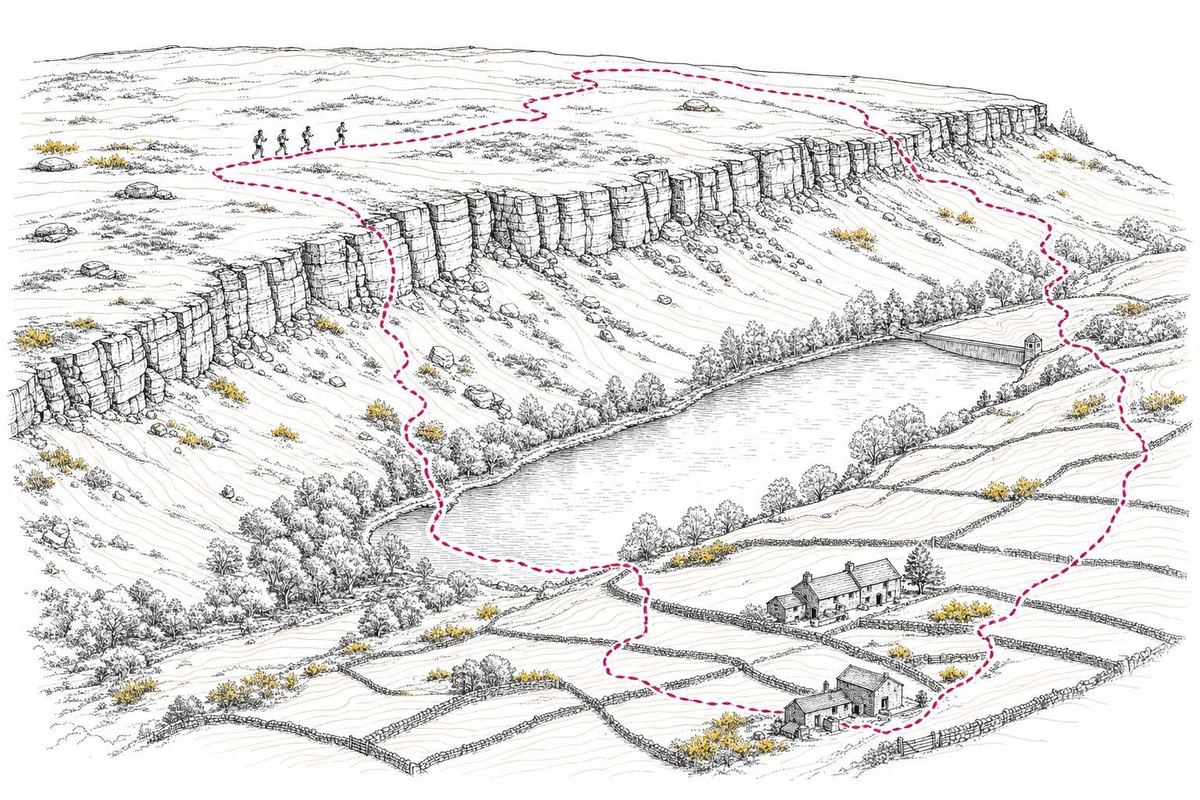
Peak District trail races have a particular character, and the five routes on this sheet show it well. None of them has a single brutal climb on the Peak District trails they use. Instead the ground keeps tipping up and down, from the edge of Sheffield into the moors, over gritstone and limestone, along tracks that are runnable one minute and bouldery the next. The routes covered here range from a 10k round a working farm to a 60-mile ultra with published finishing times of between nine and twenty-two hours.
All five were built around one base: Whirlow Hall Farm, an educational charity farm on Whirlow Lane in the south-west of the city. For several years the farm hosted a late-August weekend of racing, with the long ultras on the Saturday and the shorter races on the Sunday, camping in the fields and the finish line a few metres from the farmyard. The Ultra Tour of the Peak District and the 12.12 were first run in 2012; the 50-mile and 30-mile races were added later, and the 10k grew out of a race the farm had already been staging for its autumn fundraiser.
This site treats those courses as a set of well-defined Peak District trails with known distances, known climbing and a known history, useful as a training target, a recce, or a way to judge which distance is the right next step.
Five Peak District trail races, one start line in Sheffield
The routes stack neatly by distance, which makes these Peak District trail races easy to compare. Each one roughly doubles the step before it, which is why runners used them as a ladder: a 10k in the first year, the 12.12 the next, a first ultra after that.
- Whirlow 10k trail challenge. Billed as "six country miles", which is about 10 kilometres. Uphill for most of the first half, downhill for most of the second, and a hard push uphill to finish. Minimum age 16. Read the Whirlow 10k route guide.
- 12.12. 19.5 kilometres, or 12.12 miles, with about 633 metres of ascent. A Sunday race with a 10am start. The full picture is in the 12.12 guide.
- Peak Trails 30. Thirty miles with about 1,388 metres of climbing. It was first called the "Intro Ultra", because the distance sits just inside the ultra category. See the first ultra guide.
- Peak Trails 50. Fifty miles and about 2,600 metres of ascent, starting at 6am alongside the longest race. The Peak Trails 50 page covers it.
- Ultra Tour of the Peak District. Around 60 miles, or 100 kilometres, with 2,722 metres of ascent in 2016 and about 3,222 metres after a reroute in 2018. Support stations at Moscar, the foot of Win Hill and Bradwell. The Ultra Tour route guide goes checkpoint by checkpoint.
For runners further east there was a second, flatter set of courses in Suffolk, based at Wantisden Hall near Woodbridge: a 50-mile Ultra Tour of Suffolk, a 28-mile intro ultra, the Rendlesham 20k and a 5.5-mile dash. Those are covered on the Suffolk trail races page.
How hilly is hilly? The ultra routes in numbers
The phrase that appeared on every course description was "no monster climbs". It is accurate and slightly misleading at the same time. Divide the published ascent by the distance and the four longer routes land in a tight band: the 60-mile Ultra Tour climbs about 54 metres per mile, the 50 about 52, the 12.12 about 52 and the 30-mile race about 46. That is steady climbing all day, with no long flat stretch to recover on.
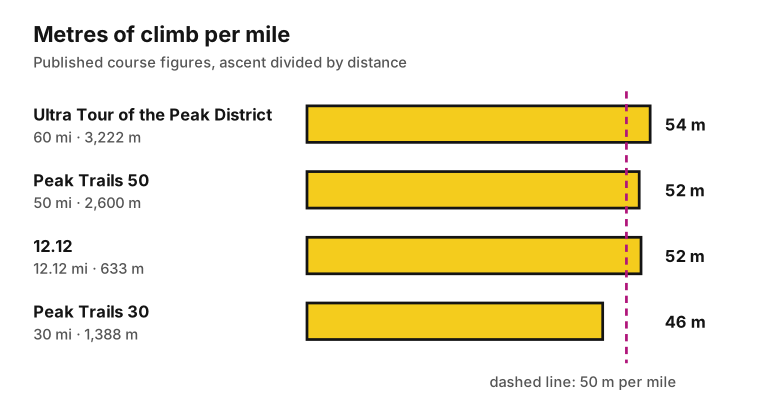
For comparison, a road marathon in a hilly city might gain 300 to 400 metres over 26 miles. The Peak District trails on these routes ask for three to four times that rate, repeated for six, ten or eighteen hours. The climbs are short enough to run the bottom of, and long enough that many runners end up walking the top.
That profile has a practical consequence. Training for these races is less about one big hill session a week and more about legs that tolerate constant gradient changes: descending on tired quads, climbing with a hands-on-knees walk, then running again straight away on the flat.
Which distance to choose from Sheffield's doorstep
A sensible rule for moving up the ladder: double the distance, not more, between seasons. The briefing notes for the longest race described its drop-out rate as high, which is a good reason not to skip steps.
| If your longest run so far is | A sensible next route | Why |
|---|---|---|
| Road 10k or parkrun | Whirlow 10k | Same distance, but with real trail underfoot and a climbing first half. |
| Hilly half marathon | 12.12 | Slightly shorter than a half, but with 633 metres of ascent and rougher ground. |
| Trail marathon | Peak Trails 30 | Four miles further than a marathon, built as a first ultra. |
| A 30-mile ultra and several long hilly days | Peak Trails 50 | Most of the long route's character without the night section. |
| A 50-mile finish and confident navigation | Ultra Tour of the Peak District | The full loop, a head torch on the kit list, and checkpoints with strict cut-offs. |
The 30-mile race is the obvious entry point into ultra running here. Its start was two hours later than the longer races, at 8am, and it was explicitly pitched at runners "after their first ultra scalp". The longer races are a different undertaking. The 60-mile route in particular expects navigation skills, a full kit list and the ability to keep moving through the evening.
What the ultra races in the UK usually ask, and what these asked
Most ultra races in the UK work from a similar rulebook, and these routes followed it closely. A few points mattered on race day and still matter for anyone running the routes on their own.
Dibbers instead of marshals at every turn
Timing used SportIdent dibbers: a small electronic chip on the finger that registers at each control box. Every dibbing point had to be visited. Missing one added a time penalty, which on the 30-mile race ranged from ten to fifty minutes depending on the checkpoint, plus a further hour for missing two in a row. Penalties were not reviewed afterwards against GPS tracks, which made the dibbing record the final word.
Marking, and when it is not enough
The longer routes were partially or fully marked depending on the year, but the briefing always added a condition: navigation may be needed if the weather turns. On the high moor west of Sheffield a marker is useless once the cloud comes down, so the compass and the full route map on the kit list were not decorative.
Route restrictions
The courses were drawn up with local landowners and the Peak District National Park Authority, and some sections carried strict restrictions to keep runners off sensitive ground. Anyone recceing the routes today should stick to public rights of way and open access land, and check the Countryside Code guidance from the National Park before heading out.
Poles yes, pacers no
Walking poles were allowed on the ultras. Pacers were not. Head torches were mandatory on the long routes, although runners could drop them at the Bradwell checkpoint once daylight was no longer in question.
The kit list for a Peak District ultra
The mandatory kit on the Ultra Tour was short and practical, close to what other ultra races in the UK ask for on open moorland, and it is a good baseline for any long day on these moors:
- full body cover that is windproof and waterproof
- compass and the full route map
- spare water and food
- whistle
- head torch
- mobile phone
The 50-mile list was the same without the head torch requirement in its published version, and the 30-mile race used the same core list. Two additions are worth considering on a solo recce: a foil blanket and a printed copy of the route, because phone batteries fade quickly on cold, wet days. The Met Office mountain forecast for the Peak District is the most useful single check before a long run on the high ground.
Cut-offs on the 60-mile loop
The longest race ran with three support stations, each with its own drop bag and its own cut-off. In 2016 the first was at Moscar, on the moorland road west of Sheffield, four and a half hours after the 6am start. The second sat at the bottom of Win Hill, nine and a half hours in. The third, at Bradwell in the Hope Valley, closed fourteen and a half hours after the start, at 8.30pm. Finishers took anywhere from about nine to twenty-two hours.
Those numbers set the pace for everyone at the back of the field: a little over three miles an hour, including stops, is enough to stay ahead of the cut-offs. The middle cut-off, at the foot of Win Hill, is the one that leaves the least slack: five hours for the leg from Moscar.
Peak District trails beyond race day
Because the courses use public rights of way and established tracks, these Peak District trail races work well as training routes outside any event. A few things make a self-supported day on these Peak District trails go better:
- Recce in sections. The long loop splits naturally at the support station villages, and the Hope Valley railway line makes it possible to run one section and take the train back to Sheffield.
- Carry the map, not just the GPX. Paths fork on the moor, and a line on a watch screen does not show where a wall or a bog sits.
- Respect lambing and nesting seasons. Dogs on leads, gates left as found, and no shortcuts across fields.
- Tell someone the plan. Mountain rescue in the Peak District is run by volunteers, and the Mountain Rescue England and Wales site explains how to call them out properly.
Whirlow Hall Farm: the charity behind the start line
The race weekend had a beneficiary from the start. Whirlow Hall Farm Trust was founded in 1979 as an educational charity working with inner-city children and young people, including children with special needs or disabilities. More than 250,000 children have visited the farm for day sessions or residential stays: pond dipping, farm jobs, pony riding and lessons on where food comes from. The charity page has more on the trust and on running for it.
A short history of the race weekend
The first Ultra Tour of the Peak District and the first 12.12 ran in 2012 as part of a "Big Running Weekend" in Sheffield. The organiser was Eight Point Two, a Sheffield company with a background in challenge events such as mud runs and the Whole Hog races. The events were popular enough to return the following year and settled into a fixed late-August slot at Whirlow, with a festival feel: camping, food on site and races finishing all weekend.
By 2016 the line-up was the 60-mile Ultra Tour, the 30-mile Intro Ultra, the 12.12 and the Whirlow 10k. By 2018 the long route was listed as a qualifier for the Ultra-Trail du Mont-Blanc, and that year land-use restrictions forced new routes for the two longest races, adding climbing: the Ultra Tour went from about 2,722 to 3,222 metres of ascent, and the 50-mile race, rerouted the same year, came in at about 2,600 metres. Running club reports from Sheffield describe the Dig Deep weekend continuing in later years under new organisation, with a 50-mile race and shorter distances on the same farmland south-west of the city.
Current dates, entry details and results are published by the event organiser, not here. The guides on this site describe the courses, their published figures and what it takes to run them.
Questions about the Peak District trail races
Where do the races start?
All five courses on this sheet start and finish at Whirlow Hall Farm, Whirlow Lane, on the south-western edge of Sheffield, close to the boundary of the Peak District National Park.
Which is the easiest route for a first trail race?
The Whirlow 10k. It is about 10 kilometres on farm tracks, grassland, field edges and a little open moorland. It still climbs for most of the first half, so it is a real trail race rather than a road 10k on grass.
Is the 30-mile race a proper ultra?
Yes. Anything longer than a marathon counts as an ultra, and 30 miles sits just inside the category. It was originally named the Intro Ultra for exactly that reason.
How long is the Ultra Tour of the Peak District?
About 60 miles, or roughly 100 kilometres, with around 2,722 metres of ascent in 2016 and about 3,222 metres on the rerouted course from 2018.
How long do runners take on the 60-mile route?
The published course times ran from about 9 to 22 hours. The final support station at Bradwell closed fourteen and a half hours after the 6am start.
Did the Ultra Tour count for UTMB?
Yes. The 2018 race information listed it as a qualifying race worth 4 points for the Ultra-Trail du Mont-Blanc. The UTMB qualification system has changed since then, so anyone planning around it today should check the current rules.
Are the routes marked?
Partly or fully, depending on the year, but every briefing warned that navigation may be needed in poor weather. The kit list included a compass and the full route map for that reason.
What is a dibber?
A small SportIdent electronic chip worn on a finger. Runners insert it into a control box at each checkpoint, which records the time. Every dibbing point on these courses had to be visited.
What happens if a checkpoint is missed?
A time penalty. On the 30-mile race the penalties ranged from 10 to 50 minutes per checkpoint, with an extra hour for missing two in a row.
Are walking poles allowed?
Poles were allowed on the ultras. Pacers were not.
What is the minimum age?
18 for the ultras and the 12.12, and 16 for the Whirlow 10k. None of the races had an upper age limit.
What kit is mandatory on the ultras?
Windproof and waterproof full body cover, a compass and full route map, spare water and food, a whistle, a head torch on the long route, and a mobile phone.
Could runners camp at the start?
Yes. Camping was available on site at the farm, with food, drinks, toilets and changing facilities over the race weekend.
When in the year were the races held?
Late August. In 2016 the ultras ran on 20 August and the shorter races on 21 August; in 2018 the dates were 25 and 26 August.
Can the routes be run outside the race?
They follow public rights of way and established tracks, so sections can be run any time. Some race-day restrictions protected sensitive ground, so recce runs should stay on public paths and open access land.
Who benefited from the race entries?
Whirlow Hall Farm Trust, the educational charity that runs the farm used as the race base, was the main beneficiary.
Is there a flatter alternative?
The Suffolk courses were the flat counterpart: forest, heath and a stretch of coast, with a 50-mile ultra, a 28-mile intro ultra, a 20k and a 5.5-mile dash, all from Wantisden Hall near Woodbridge.