 Dig Deep Races
Route card · 12.12 miles · Sunday 10am
The 12.12 trail race: 19.5 km and 633 metres of climbing from Whirlow
- 19.5 km / 12.12 miDistance
- 633 mAscent
- 10amStart
- 18Minimum age
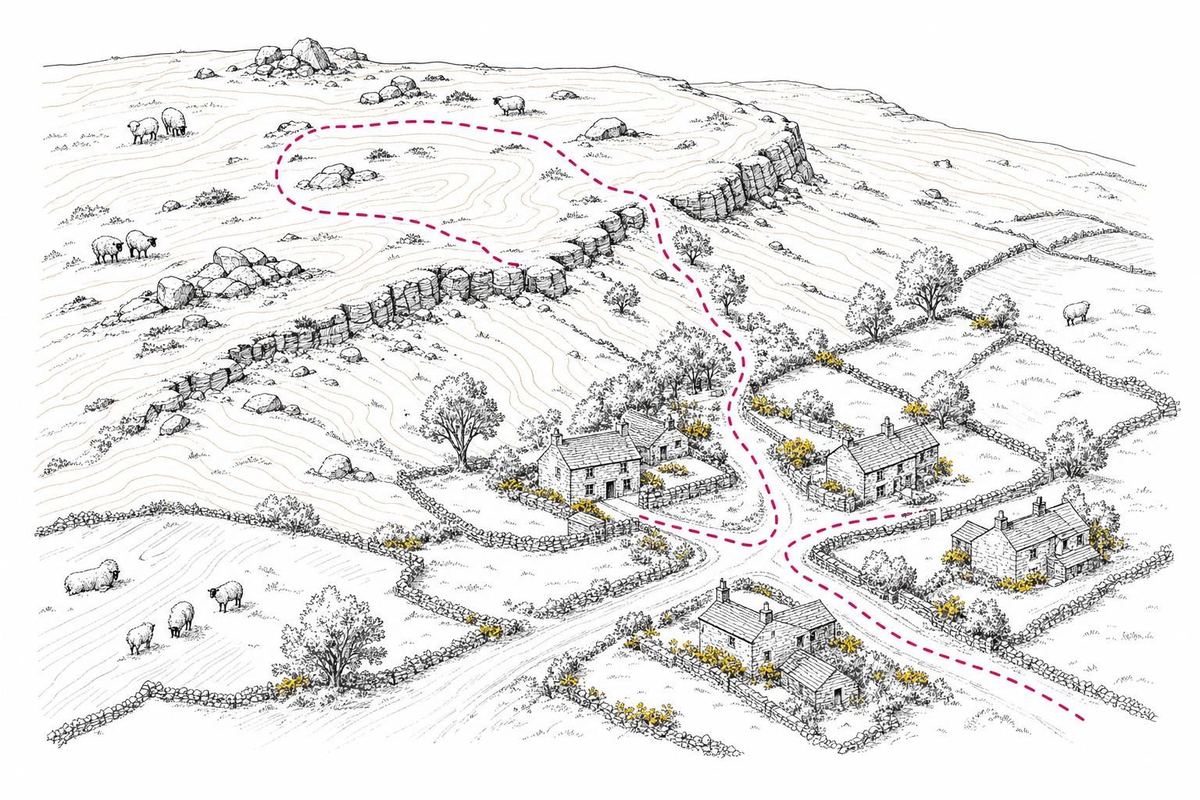
The 12.12 takes its name from its length: 12.12 miles, or 19.5 kilometres. It was one of the two original races on the Whirlow weekend, first run in 2012 alongside the Ultra Tour of the Peak District, and it kept its Sunday morning slot in the years that followed.
A short race with a lot of climbing
The published figure for the 12.12 is about 633 metres of ascent. Spread over 19.5 kilometres, that is about 52 metres per mile, the same rate as the long ultras. The course description repeats the phrase used for the longer routes: no monster climbs, but a continuously hilly route that makes it a tough race to complete.
For anyone used to road racing, 633 metres is a lot. A typical road half marathon climbs far less. Expect a finishing time well beyond a road half marathon time, even though the 12.12 is shorter.
Terrain and navigation
Most of the route runs on good tracks and public rights of way, with some trickier ground where navigation may be needed. It was marked in most areas, but the briefing warned that some navigation could be necessary in poor weather. Like the ultras, it was planned with landowners and the Peak District National Park Authority, with route restrictions on sensitive sections.
SportIdent dibbing stations sat along the route, and the rule for the 12.12 was stricter than on the ultras: missing a dibbing point meant disqualification, not a time penalty.
Race day
- Start: 10am on the Sunday, twenty minutes before the Whirlow 10k.
- Registration: 6pm to 8pm on the Saturday evening and from 8am on race morning.
- Minimum age: 18, no upper limit.
- Facilities: food, drinks, toilets, changing and camping at the farm.
Kit and booking
Short as it was, the 12.12 had a mandatory kit list: full body cover that was windproof and waterproof, a compass and the full route map, spare water and food, and a whistle. Runners found without the minimum kit were disqualified, a rule the race information printed in capital letters. On a warm August morning that can feel like a lot to carry for 19.5 kilometres, but the open ground above Sheffield changes quickly, and the kit is what makes a twisted ankle on the moor an inconvenience rather than an emergency.
Entries had to be booked in advance, online or by post, and the fee covered a T-shirt and a medal. Race numbers were collected at registration.
Pacing a hilly 19.5 km
The usual mistake on a short hilly race is to run it like a road race: go out at a steady pace, hold it, and suffer on every climb. On a course with 633 metres of ascent it works better to run by effort rather than by pace. Walk the steepest sections briskly from the start, because a fast hike costs very little time on a steep slope and saves a great deal of energy. Use the descents to recover breathing while keeping the legs moving quickly, and keep something back for the last climb.
Training for it is straightforward. Hill repeats on grass or trail once a week, one longer run of 90 minutes to two hours on hilly ground, and a couple of runs that include steep descents are enough for most runners who already run regularly. The race is short enough that fuelling is simple: water and a gel or two cover it.
Where the 12.12 fits
The 12.12 is the bridge on the distance ladder. It is about twice the length of the Whirlow 10k and has the same climbing rate as the ultras, which makes it a useful test before a first ultra over 30 miles. A runner who finishes the 12.12 feeling strong on the last climb has a good base for the longer distance; one who walks the second half has learned something useful about pacing on hilly ground.
It also works well as a standalone race for strong road runners who want to see what trail racing in the Peak District is about without committing a whole day to it. The full set of routes is on the races overview.
Questions about the 12.12
Why is it called the 12.12?
Because the course is 12.12 miles long, which is 19.5 kilometres.
How much climbing is there?
About 633 metres of ascent.
What happens if a checkpoint is missed?
Disqualification. Every dibbing station on the 12.12 had to be visited.
When was it first held?
In 2012, alongside the first Ultra Tour of the Peak District.
What is the minimum age?
18, with no upper age limit.